
 |
|
::
Gurudwara in & Around Amritsar |
|
THE HARIMANDIR SAHIB
::
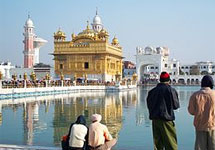
Sri Harimandir Sahib , (now
called the Golden Temple Amritsar), is a living symbol of spiritual and
historical traditions of the Sikhs. The Holy tank and the temple have been a
source of inspiration to the Sikh community ever since their foundation. The
foundation of Sri Harimandir Sahib is the most significant achievement of the
Sikh Gurus as a centre of inspiration and action for the Sikhs. Soon after its
foundation the temple became an unparalleled establishment as a place of
pilgrimage. The origin of the place where Sri Harimandir Sahib stands is
shrouded in mystery. Some traditions trace its origin from the pre-historic
period as a place of considerable religious importance in the form of an Amrit
Kund (Spring of Nectar).
Legends and miracles are connected with the origin of the Amrit Sarowar (Tank of
Nectar). Sri Guru Amar Das Jee found at the edge of the pool the desired herb to
cure the skin ailment of Guru Angad (the second Guru of the Sikhs). However, the
persistent local tradition best highlighting the medicinal properties of the
water of the pond is the story of Rajni, daughter of Rai Duni Chand, a Kardar
(revenue collector) of Patti, and the subsequent cure of her leprous husband
after taking a dip into the pond.
The tank was named Amar Sarowar or Amritsar. The fame of the sacred tank led to
its identity with the latter appellation and the city got its final name 'Amritsar'.
Sri Harimandir Sahib got the name of Golden Temple when its upper part sheathed
in richly embossed and highly gilded sheets was covered with gold all around it
during the period of Maharaja Ranjit Singh. Maharaja Ranjit Singh granted rupees
5 lakhs for placing golden plates on Sri Harimandir Sahib in I803. It is evident
from the inscription on the gold plate engraved over the entrance gate on the
north-eastern side of the central shrine that the gold service of the temple was
got done by Maharaja Ranjit Singh through the supervision of Bhai Sant Singh
Giani in 1830. Bhai Sant Singh Giani appointed Mohammad Yar Khan Mistri as
technical expert for the task of gold-plating. The greater part of the
architectural structure of the present building of Sri Harimandir Sahib was
constructed and decorated in the nineteenth century. The architecture of the
Golden Temple represents the highest achievement of the Sikhs in art and
architecture. The allied arts of decoration, naqashi and frescoes inside the
temple display the skilled craftsmanship of the Indian artists of the nineteenth
century. No building in the world can vie with the Golden Temple where nature
and art have been treated in such a harmonious blending so beautifully.
The Golden Temple (also called Sri Darbar Sahib) is not only a place of worship
but a rallying centre of the Sikh community. Sri Harmandir Sahib is the heritage
of the Sikh people gathered in their five hundred years old history. Legends and
miracles are connected with the holy tank while great martyrdoms and triumphs
are associated with various spots of the temple precincts. The temple had been a
symbol of the Sikh struggle for independence in the eighteenth century. In the
nineteenth and twentieth centuries all important Sikh movements have been led
from the precincts of Sri Harmandir Sahib (Golden Temple). |


 |
|
|
|
SRI AKAL TAKHAT
::
Adjacent to Sri Harmandir sahib
(Golden Temple, Amritsar), is the marble paved square facing the Darshni Deorhi.
On the opposite side of the marble square stands Sri Akal Takht, which is
regarded as the supreme seat of Sikh religious authority. It was constructed by
the sixth Guru Sri Hargobind in 1609. It is also called as Akal Bunga, the house
of the Lord. Sri Akal Takhat Sahib is repository of the various weapons used by
Sikh Gurus and heroes. These weapons are ceremoniously displayed every evening
to the congregation of devotees. Sri Akal Takht Sahib being the holiest of holy
seats of the Sikhs, was used for a special purpose which considerably changed
the Sikh character and organization. The sixth Guru himself sat here and held a
court of justice. Many Sikhs gathered here for the redressal of their
grievances. Offerings were made to the Guru.
The Hukamnama issued by Jathedar of Akal Takht is binding on all Sikhs. Even
Maharaja Ranjit Singh had to bow before the orders of the Jathedar of the Akal
Takht. During the Misal period after the death of Guru Gobind Singh and before
the rise of Maharaja Ranjit Singh, Gurmata used to be passed by Sarbat Khalsa at
Akal Takht for the protection of the country from the invaders. |
 |
|
|
|
GURUDWARA BABA ATAL -
AMRITSAR ::
Gurdwara Baba Atal has been
raised in the revered memory of Guru Hargobind’s 9 year old Sahibzada Baba Atal
Rai. It is situated in Amritsar. The child was the personification of something
wondrous. Through a miracle Baba Atal Rai once revived a dead child. Guru
Hargobind was convinced that Sikh religion did not believe in any kind of
miracle and that it was an uncalled for interference in the ways of god and the
cosmic system. The Guru, therefore, felt annoyed with his son. To atone for the
intervention in the divine ways, the child left for his heavenly abode. It is at
the point of the terrestrial exist of Baba Atal Rai that a nine storeys Gurdwara
symbolic of his 9 years of exisatence was constructed. It is known as Baba Atal |
 |
|
|
|
GURUDWARA RAMSAR SAHIB - AMRITSAR ::
Among the other famous
historical shrines located in the city of Amritsar is the Gurudwara Ramsar Sahib
situated on the bank of the pool of the same name. Located north-east from the
Golden Temple, this place is, where Guru Arjun Dev for a year or more went into
seclusion along with his scribe, the great savant Bhai Gurdas to compile the
holy Adi Granth. The sacred volume was completed in 1604 and installed with due
honor and ceremonies in the Harmandir Sahib. In this holy book, Guru Arjun Dev
collected the hymns of first four Gurus, namely Guru Nanak Dev Jee, Guru Angad
Dev Jee, Guru Amar Das Jee, Guru Ram Das Jee and adding his own compositions as
well as selections from the writings of the Hindu and Muslim mystic saints.
This holy Adi Granth was arranged according to the musical measures or notes in
which they were intended to be sung. The holy book was given the status of the
Guru by Guru Gobind Singh. Just before he left for his abode in heaven on
October 7, 1708, in his wisdom he proclaimed, "Accept Guru Granth Sahib as the
visible image of the Guru. Those whose hearts are pure can find the truth in the
shabad". This was the last injunction to the Sikhs of the Tenth Guru. He put an
end to apostolic succession and enjoined upon the Sikhs to look upon the Granth
Sahib as their only Guru in future. There lies the importance of the place where
this sacred volume was compiled by Guru Arjun Dev. Gurudwara Ramsar is held in
great reverence by the Sikhs.
Gurudwara Ramsar Sahib stands on the bank of the Ramsar sarovar, near Chativind
Gate, on the southeastern side of the walled city. After the completion of the
Harimandar, Guru Arjan undertook the compilation of Adi Granth, the Holy Book,
now revered as Guru Granth Sahib. For this task, he chose a se-cluded site. The
spot selected was then a shady nook, one km away from the bustle of the town. To
make the surroundings more agreeable, he had a tank dug which was named Ramsar
after Guru Ram Das. Here, Guru Arjan composed his famous Sukhmani Sahib , the
Psalm of Peace, and with Bhai Gurdas as his scribe compiled the Adi Granth
during 1603-04. The present Gurdwara Ramsar, a small marble-lined hall topped by
a gilded, fluted lotus dome built in 1855, marks the site of the Guru's labours. |
 |
|
|
GURUDWARAS CHHEHARTA SAHIB ::
Guru ki Vadali is the
birthplace of the Sixth Guru, Sri Guru Hargobind Sahib, the son of Guru Arjan
Dev Ji. To celebrate the birth of his son, Guru Arjan DevJi constructed a big
well at this place. This well had six Persian wheels to draw out the water and
thus came to be known as Chheharta, the well with six wheels. This well helped
in removing water scarcity in the region and enabled the greening of the fields. |
 |
|
GURUDWARA BABA BAKALA DISTT. AMRITSAR ::
The historical shrine at Baba
Bakala is associated with an important event in Sikh history. Here Makhan Shah
Lubana declared from house top that he had found the true Guru. It may be
recalled that before his death at Delhi on March30, 1664 Guru Harkrishan Jee
mumbled feebly 'Baba Bakala', thereby meaning that his successor was to be found
at Bakala village in Amritsar. On that day, the only Baba at Bakala was Baba
Tegh Bahadur and none else. But many imposters tried to grab the Guru Gaddi by
posing themselves as the real Guru. Credit goes to Makhan Shah Lubana, a banjara
trader from Jhelum district, for discovering the Guru. It is said that a ship
carrying his goods was caught up in a storm. His life and goods were in great
danger. Helplessly, he knelt down and prayed to God and Guru Nanak for safety.
He vowed that if by the grace of Guru he landed at the nearest port safely, he
would donate five hundred dinars to the Guru for charitable purposes.
As good luck would have it, his ship steered safely of the wild storm. He felt
that his life and goods were saved by the grace of the Guru. The first thing he
did was to fulfill his vow. But on reaching Baba Bakala he found several
imposters, each posing as Guru. He decided to offer only two Dinars to every one
posing to be Guru Harkrishan's successor. The true Guru would himself demand the
exact amount he had vowed to give. According to him it would not be possible for
the false and imposters to define the exact purpose of his visit. Thereby their
ignorance, lack of spiritual insight and character would be exposed.
As expected ,none of the imposters could recognise him. But when he placed two
Dinars before Guru Tegh Bahadur, the great sage at once remarked "God bless you,
my man, why only two Dinars after pledging five hundred? The Guru is never in
need of any thing but a Sikh is expected to keep his pledge to the Guru." Thus
the issue was clinched and the real Guru was discovered. Since this historic
event Bakala has become a place of pilgrimage. A beautiful Gurudwara stands at
the spot where Guru Tegh Bahadur used to meditate in an underground cell. This
small village where Guru Tegh Bahadur revealed himself subsequently, came to be
called BabaBakala. The Gurudwara has many beautiful paintings pertaining to the
Sikh history. People gather in thousands on every amavas night. Besides an
Annual Fair is held on rakshabandhan day when many people throng this holy place
from all over the country. It is situated approximately 40 KM from Amritsar. |
 |
|
|
GURUDWARA MANJI SAHIB - AMRITSAR ::
Guru ki Vadali is the
birthplace of the Sixth Guru, Sri Guru Hargobind Sahib, the son of Guru Arjan
Dev Ji. To celebrate the birth of his son, Guru Arjan DevJi constructed a big
well at this place. This well had six Persian wheels to draw out the water and
thus came to be known as Chheharta, the well with six wheels. This well helped
in removing water scarcity in the region and enabled the greening of the fields. |
 |
|
|
|
GURUDWARA GURU KI WADALI ::
Guru Hargobind Jee, the sixth
Guru of the Sikhs was born on June 14,1595 at village Wadali, near Amritsar
city. The birth place of the Guru has beautiful shrine named as Gurudwara Guru
Ki Wadali. This small village has become a place of pilgrimage, where devotees
come from far and near to pay homage to Mata Ganga Jee who gave birth to the
great Guru, the giver of a new direction to the Sikh faith. |
 |
|
|
GURUDWARA KHADUR SAHIB - DISTT AMRITSAR ::
Gurdwara Sri Khadur Sahib close
to Goindwal, is the sacred village where the second Guru Angad Dev Jee
propagated the message of God, for many years. A grand Gurudwara Khaddi Sahib,
has been constructed here, in memory of Guru Amar Das. The spot where the
Gurudwara stands today, was located a khaddi (loom) of a cloth weaver. One dark
night Guru Amar Das stumbled into a weaver pit, while carrying pitcher of water
on his head. He was fetching water from river Beas at a distance of 10 km, for
his Guru Sri Angad Dev. Notwithstanding his fall, he succeeded in saving the
water filled pitcher. The noise of the fall awakened the weaver who suspected a
thief. When weaver's wife heard a voice uttering 'Japji' she remarked that there
was no thief but poor, homeless Amar. When the incident came to the notice of
Guru Angad, he was pleased to observe, 'Amar Das was not homeless and lowly. He
shall be the home of the homeless, and honour of the unhonoured, the strength of
the strengthless, the support of the unsupported, the shelter of the shelterless,
the protector of the unprotected, and the emancipator of the captives.
Guru Angad Dev Jee then formally held the investiture ceremony, appointed Guru
Amar Das Jee as his successor and the third Guru. There are two other Gurdwaras
namely Thara Sahib and Killa Sahib located. at Khadur Sahib associated with Guru
Amar Das ji. Gurudwara Thara Sahib, stands on the spot where Guru Amar Das
received tilak (anointment) as Guru from the blessed hands of Baba Budhaji who
performed Tilak ceremonies of five Sikh Gurus. He was also the first head priest
of the Golden Temple. Gurudwara Killa Sahib is located where Guru Amar Das used
to place his pitcher full of water for a moment's respite, from fatigue of the
long tiring walk.
Gurdwara Mal Akhara is associated with the place where Guru Angad Devji
finalised Gurmukhi script. The Gurdwara has a fine hall with canopied doors. |
 |
|
|
GURUDWARA SAN SAHIB, BASARKE,
DIST. AMRITSAR ::
Guru Amar Das was forced to
leave Goindwal by Datu the son of Guru Angad Dev Jee who was jealous at not
being named the Guru by his father. Datu told Guru Amar Das Jee to leave
Goindwal, and being the humble person that he was, Guru Amar Das Jee returned to
his family village of Basarke. Here the Guru shut himself up in a small hut with
a note on the door, 'He who opens this door is no Sikh of mine, nor am I his
Guru.' When a delegation of Sikhs lead by Baba Buddha finally found the hut they
were perplexed as what to do. Finally they decided to make a hole in the wall so
as not to go against the Gurus injunction. Once inside they pleaded with the
Guru to return to Goindwal as only he was their true beloved Guru and the Sikhs
could not live without him. Guru Amar Das finally relented and returned with the
Sikhs. The hole in the wall is still preserved today inside the Gurdwara. |
 |
|
|
GURUDWARA BABA DEEP SINGH JEE SAHID, AMRITSAR ::
Baba Deep singh Jee was born on
the 20th January 1682 A.D. in the village of Pahuwind in district of Amritsar.
His father's name was Bhai Bhagtu. He went to Anandpur on the Vaisakhi of 1700
A.D., where after obtaining baptism (into Sikhism) he started learning weaponry
and riding from the Sikhs. From Bhai Mani singh he began learning reading and
writing Gurmukhi and interpretation of Guru's word. After spending two years at
the Guru's institution, he returned to his village in 1702 A.D. got married and
started living there. He went to Guru Gobind Singh at Talwandi Sabo in 1705 AD
where he helped Bhai Mani singh in making copies of Guru Granth sahib Jee. After
the Guru Sahib Jee left for Delhi, he took up the service of looking after
Gurudwara Damdama sahib.
In 1709 A.D., he joined Baba Banda singh Bahadur in chastising the tyrants of
Sadhaura and Sirhind. in 1733 A.D. Nawab Kapoor singh Singhpuria appointed him a
leader of one squad. On Vaisakhi day of 1748 A.D., when Dal Khalsa was
reorganized into twelve misls, he was entrusted with the leadership of Shaheedan
Misl. In April 1757 A.D., Abdali during his fourth invasion was returning to
Kabul from Delhi with precious booty and young men and women as captives, Singhs
made a plan to rob him of the valuables and set the prisoners free. The squad of
Baba Deep singh was deployed near Kurukshetra. His squad freed large number of
prisoners and lightened the burden of valuables of Abdali considerably. While
departing from Lahore, Abdali appointed his son Taimur Shah, the Governor of
Lahore and told him, "Try to finish the Sikhs". In Accordance with his orders
Taimur Shah started demolishing Gurudwaras and filling the holy pools with
debris.
When Baba Deep singh Jee came to know of the demolition of Harminder Sahib, he
narrated it to the congregation of Damdama Sahib and said, "Diwali will be
celebrated at Amritsar this year." Five hundred Singhs came forward to go with
him. Baba Deep Singh offered prayers before starting for Amritsar, "My head may
fall at Harminder Sahib." By the time squad reached Taran Tarn the number of
Singhs going with Baba Deep singh reached approximately Five thousand.
At the news of the approach of Singhs, the Governor of Lahore sent his general
with an army of Twenty thousand to face them. His army took up positions Six
miles north of Amritsar and waited for the Singhs there. Both the armies clashed
near Gohalwar on the 11th November, 1757 A.D. Fighting bravely Singhs pushed the
army back and reached village Chabba where General Attal Khan came forward and
inflicted a blow on Baba Deep Singh ji which made his neck lean to one side. A
Sikh reminded him, "You had resolved to reach the periphery of the pool." On
hearing the talk of the Sikh, he supported his head with his left hand and
removing the enemies from his way with the strokes of his double-edged sword
with his right hand, reached the periphery of Harmindar Sahib where he breathed
his last. The Singhs celebrated the Diwali of 1757 A.D. in Harminder Sahib. |
 |
|
|
GOINDWAL SAHIB ::
Guru Amar Das Ji established
Sri Goindwal Sahib. It was the first center of Sikhism. Guru Amar Das Ji felt
that there should be a Sikh Pilgrimage site, so he purchased the land and
constructed the Gurudwara with a baoli (well) having 84 steps. Guru Amar Das Ji
said that those who want to salvation should visit the holy shrine and recite
the Japji Sahib Path (Prayer) with a pure heart on each step leading to the well
before taking a plunge in the holy water of the well. |
 |
|
|
GURUDWARA TARAN TARAN ::
Gurudwara Taran Taran Sahib is
located at a distance of 25 kilometers south of Amritsar. Just like Dukh
Bhanjani Beri in Sri Harmandir Sahib (Golden Temple), the Sarovar in this
Gurudwara also possess healing powers. As the folklore goes, it is believed that
any Leper who can swim across the Tank will be miraculously cured. The Tank is
large so Parikrama (walking along the tank or pool with incantation) takes some
time. |
 |
|
|
GURUDWARA DAMDAMA SAHIB, BHATHINDA ::
TAKHAT SRI DAMDAMA SAHIB,
Talwandi Sabo, Bhatinda, is the fifth seat of the authority of Sikhs. This place
owes its importance to the literary work of Guru Gobind Singh Ji done here
during his stay in 1706. It was at Damdama Sahib that Guru Gobind Singh Ji
prepared the revised & authentic version of the Adi Granth which is now being
honored by the Sikhs as Guru Granth Sahib ji. He added to the original version
prepared by Guru Arjan Dev Ji the verses of Guru Teg Bahadur Ji. A large number
of new converts joined the fold of the Khalsa here. Guru Gobind Singh Ji stayed
at Damdama Sahib for nearly a year.
After leaving the fort of Sri Anandpur Sahib & passing through Chamkur Sahib,
Maachiwara, Deena Kangar followed by historic war of battle in Mukatsar. Guruji
arrived in Talwandi Sabo in the Year 1705 on a high elevated small piece land.
On that place Guruji took a break & relaxed. Due to this reason this pious piece
of land is famous as Damdama Sahib. From Damdama sahib Guruji released
orders(Hukamnama) for Sikh Desciples & announced or rather declared this sacred
place as a Takhat. According to Dr. Trump's writings in 1706 Guruji Baptised
around 1.2 lac devotees on the occassion of Baisakhi's Get together(Jor Mela).
Maintaining the same custom, every year Baisakhi's festival is celebrated in
same way here & lacs of devotees come here to get Guruji's blessings even today. |
 |
|
|
GURUDWARA MANJI SAHIB - SRI HARGOBINDPUR ::
During his stay at Sri
Hargobindpur, Guru Hargobind Sahib Jee built a house in the new town, for his
own residence. It is a three-storeyed building. Though very much ravaged by the
passage of time, people regard it a place of pilgrimage. A kesri flag post
indicating the place can be spotted from distance.
GURUDWARA TALWANDI SABO- DISTT. BHATINDA
Talwandi Sabo is also known as Guru Ki Kashi. Here the fifth Takht of the Sikhs
is located. The other four Takhts are Akal Takht, Amritsar, Takht Keshgarh
Sahib, Anandpur, Takht Hazur Sahib, Nanded (Maharashtra) and Takht Harmandir
Sahib Patna (Bihar)
Literally, Damdama means the breathing or resting place. Dam Dama Sahib is one
of the Five Takhts of the Sikhs. It is located at village Talwandi Sabo, 28 km
southeast of Bathinda. Guru Gobind Singh stayed here after fighting battles
against Mughal atrocities. Before his arrival at Talwandi, two of the Guru’s
sons were bricked alive at Sarhind and two laid down their lives at Chamkaur
Sahib. After writing Zafarnama, Guru Gobind Singh fought a successful battle at
Muktsar and then moved towards Talwandi Sabo Ki.
While at Talwandi, Sikhs started coming to the Guru from all over Punjab and
other places. Here a Gurdwara was erected in Guru's memory. This place is also
known as Guru -Ki -Kanshi as it was made a center of the Sikh learning.
Damdame Wali Bir of Sri Guru Granth Sahib was prepared here by Guru Gobind
Singh. It was transcribed by Bhai Mani Singh. The hymns of Guru Tegh Bahadur
Sahib were added into the Bir.
It was at Dam Dama Sahib that Bhai Dalla was tested for his bravery by Guru
Gobind Singh and brought into the order of Khalsa. It was from Damdama Sahib
that the Guru moved towards south. In the meantime, Aurangzeb died and the Guru
helped Bahadur Shah, Aurangzeb's eldest son to sit on the throne.
This Takht was officially recognized as the fifth Takht on Novemver 18, 1966. On
demand from the Sikhs, a sub-committee was appointed by the Shiromani Gurdwara
Parbandhak Committee Amritsar vide General Meeting Resolution No: 789 on July
30, 1960. A report of the sub-committee containing 183 pages was received to
declare Damdama Sahib, Guru Ki Kashi as the fifth Takht of the Sikhs. A general
body meeting of the Shiromani Gurdwara Parbandhak Committee Amritsar approved
the recommendations through resolution number 32 on November 18, 1966.
It has been declared as fifth Takht by the government of India in April 1999
during tercentennial celebrations of the advent of Khalsa.
Guru Gobind Singh arrived here on 20-21 January, 1706 and camped outside the
village. The magnificent Gurudwara Sri Damdama Sahib marks the place of his stav.
Here local Chaudhari Bhai Dalla looked after Guruji with great devotion. He
refused to arrest the Guru as directed by Wazir Khan, Nawab of Sirhind.
Mata Sundri and Mata Sahib Kaur escorted by Bhai Mani Singh came here from Delhi
to meet Guruji. Guruji spent nine months of intense literary activities.
The other sacred place at Talwandi Sabo are, Jand Sahib, Tibbi Sahib, Likhansar
and Gurusar.
Besides, there are two Gurdwaras in memory of the ninth Guru Sri Tegh Bahadur,
known as Wada Darbar Sahib and Gurusar. |
 |
|
|
GURUDWARA BER SAHIB - SULTANPUR LODHI ::
During his stay at Sultanpur
Lodhi, Guru Nanak Dev Jee would go to the Bein stream every morning for bath and
meditation. There he planted a Ber (Jujube) sapling. The tree is still present.
A shrine was built there by Baba Jassa Singh Ahluwalia, the founder of the
Kapurthala State. Later on the construction of present building was started in
1938 and completed in 1942. It is all in marble and mosaic.
One day while bathing in the stream, Guru Nanak saw a peculiar light. He moved
towards the light and was drawn into the stream. People thought that he had been
drowned. But when he came out of the water after three days, he kept muttering
again and again the words, "We are neither Hindus nor Muslims, We are human
beings." All this was very strange to the people. Now large crowds came to him
to listen to his words. The Qazi of the town was considered a learned man among
the Muslims. He asked the Guru to join him in offering Namaz (prayer) in a
mosque if he really did not believe in any distinction between Hindus and
Muslims. Nanak accompanied the Qazi to the mosque. Everybody said his prayer.
But Guru Nanak Dev, however, only stood watching. When questioned by Qazi as to
why he did not join him in offerings Namaz the Guru replied that Qazi himself
was worried about a new born colt all the time. He was afraid that it might fall
into the well. With whom he was to offer prayer?
The crowd was greatly amazed. People came to believe that the Guru was a Divine
being, as he could read the inner thoughts of others.
The hallowed city of Sultanpur, where the great Guru Nanak spread first of all
his message of one God and brotherhood of mankind, has become a place of
pilgrimage. |
 |
|
|
GURUDWARA KOTHI SAHIB - SULTANPUR LODHI ::
Situated at a distance of 14 km
from the city of Kapurthala, this historical shrine is just a small room where
Guru Nanak Dev Jee is said to have been kept under house arrest by the order of
the Nawab Daulat Khan Lodhi, while accounts of the modikhana were being checked.
All this happened because of the false reports jealous elements had lodged. But
the charges proved wrong and the Nawab had to offer apologies to Nanak for
lending ears to the false reports. He promised never to do so again. He even
offered the Dewanship (Prime Ministership) of his State. But the Guru Jee
refused to accept Dewanship as he had decided to serve God through the service
of humanity. The pilgrims also visit the house where Guru used to stay in
Sultanpur. In this house his two sons Srichand and Lakhmi Chand were born. The
two-storied building along with the garden is still intact. |
 |
|
|
GURUDWARA HATT SAHIB - SULTANPUR LODHI ::
Guru Nanak Dev Jee , the
founder of the Sikh faith, spent 14 years in Sultanpur Lodhi, situated in
Kapurthala district of Punjab. His brotber-in-law, Jai Ram, got him employed in
the service of Nawab Daulat Khan Lodhi who was much impressed by the
intellectual equipment of Guru Nanak Dev Jee. The Nawab offered him the
portfolio of Household Minister but Guru Nanak Dev Jee preferred the
administration of Provision Supplies Department, the Modikhana. Probabiy it was
concerned with charitable institution, helping the poor and the needy.
As the custodian of the stores, Guru Jee worked with complete honesty. He gave
everybody his due. Unlike the previous custodians, who had become rich by
pilfering and short weighing, he always gave full measure to the customers.
Everybody was satisfied and spoke highly to the Nawab about the good work of the
Guru Jee. At the site of the store where the great Guru Jee distributed
provisions a Gurdwara has been built, with a tank adjoining it. It is called
Gurdwara Hatt Sahib, where eleven stone weights, said to have been used by the
Guru, are preserved.
There is an episode mentioned in the biography of Guru Nanak Dev Jee connected
with this place. Some jealous persons carried stories to the Nawab that Guru
Nanak Dev Jee was mismanaging the stores and squandering 'away state wealth.
However, when the accounts were checked, it was found that instead of shorfall,
there was some money in excess. Nawab Dault Khan Lodhi at once sent for his
treasurer Bhavani Das to pay the excess amount to Guru Nanak Dev Jee
immediately. He offered Nanak Rs. 3,000 as reward for honesty and efficiency. |
 |
|
|
|
GURUDWARA FATEHGARH SAHIB ::
The ancient town of Sirhind is
replete with ruins of beautiful mosques and tombs. During Mughal days it was a
town of considerable importance. Its ancient fort was built by 'Firoz Tughlaq'.
The Fatehgarh Sahib Gurdwara marks the spot, where the two brave children, the
younger sons of Guru Gobind Singh Jee died for the noble cause. They refused to
be converted to Islam during the reign of Emperor Aurangzeb.
After the heroic death of two elder sons of Guru Gobind Singh Jee, in the battle
of Chamkaur, on December 22, 1704 his two younger sons, namely, Zorawar Singh
and Fateh Singh were done to death, by being bricked alive in the fort of
Sirhind on December 28, 1704 by the order of the tyrant Nawab Wazir Khan. Mata
Gujri, grandmother of the two Sahibzadas expired due to the shock of brutal
murder of her two grand children. A Hindu Philanthropist Dewan Todar Mal
cremated three dead bodies with the help of other devotees of the Guru Jee. He
purchased the land by paying gold coins to the muslim Zamindar named Atta. Here
stands the Gurdwara Jyoti Swarup. A big hall with a seating capacity for 5,000
persons has been recently constructed. It has been named Dewan Todar Mal Hall.
At short distance is the Rauza of Hazrat Mirajabad-ud-din Alaf Sheikh Ahmed
Sirhindi. Thousands of pilgrims from all over the world visit Sirhind to pay
respects to Gurdwara Fatehgarh Sahib and Rauza Sharif. To the south-east of the
city is a Caravan Serai of the Mughal period known as Aam-Khas Bagh. It has now
been converted into a tourist complex where suitable accommodation is available
at reasonable rates. |
 |
|
|
ANANDPUR SAHIB (The City of Spiritual Bliss) ::
Anandpur Sahib is one of the
five most important religious places of the Sikhs. This is the birth place of
the Sikh faith. Here Sri Guru Gobind Singh Jee founded the Khalsa Panth on
Baisakhi day in 1699. The Takht Keshgarh Sahib stands at the place where the
tenth Master baptized the 'Panj Pyaras', the five beloved ones, and administered
Amrit to them.
Besides, there are a number of other Gurdwaras associated with Sikh history.
Gurudwara Guru Ka Mahal was built by Guru Tegh Bahadur Sahib Jee for his
residence and it was here that sons of Sei Guru Gobind Singh Jee were born.
Gurudwara Sisgani commemorates the spot where the head of ninth Guru Tegh
Bahadur Sahib Jee was cremated when it was brought to Anandpur Sahib by Bhai
Jaita from Delhi, after his martyrdom in Chandni Chowk in 1675.
Besides, Gurdwaras Keshgarh, Anandgarh, Lohgarh and Fatehgarh mark the spots
where once stood four fortresses built by Sri Guru Gobind Singh Jee who fought
many pitched battles against Mughal and Rajput forces.
Every year on the day following Holi, Hola Mohalla festival is celebrated at
Anandpur Sahib. On this day Anandpur Sahib relives the martial splendor of the
Khalsa under their great Guru. |
 |
|
|
GURUDWARA KIRATPUR SAHIB - DISTT. ROPAR ::
Kiratpur Sahib was founded by
the sixth Guru Sri Hargobind Sahib Jee. Here the seventh and eighth Gurus were
born and brought up. It was here that Guru Gobind Singh Jee along with his
followers received the sacred head of the ninth Guru Sri Tegh Bahadur Sahib Jee,
brought from Delhi with great devotion and respect by Bhai Jaita in 1675. The
particular spot associated with and sanctified by it, is known as Gurudwara
Babangarh Sahib. The tenth Guru took the sacred head of his father in a
procession to Anandpur Sahib for cremation. The Punjab Government has
constructed a pillar here, on which is inscribed the following quotation from
Sri Guru Gobind Singh Jee describing the unique martyrdom of Sri Guru Tegh
Bahadurji, "The Lord (Guru Tegh Bahadur) protected their paste mark (Tilak) -
and the sacred thread. A great deed he enacted in the age of kala (darkness)". |
|
|
GURUDWARA BHATHA SAHIB - DISTT. ROPAR ::
This Gurudwara commemorates the
visit of tenth Guru Sri Gobind Singh Jee. There is a fascinating story about
this place. Here by the touch of the hoof of Guru's horse the red hot brick kiln
(Bhatha) instantaneously cooled down. The then local Pathan Chief, Nihang Khan a
sincere devotee of the Guru at a great personal risk, looked after the Guru and
his followers. The gurudwara is on the main highway from Chandigarh to Kulu and
Kangra valleys. Gurdwara Bhatta Sahib is a historical Gurdwara where Guru Gobind
Singh came four times. Guru ji came here for the first time in 1745 B.K. He was
returning to Anandpur after winning the battle of Bhangani. It is said that when
Guruji asked for a place to stay, the labourers working at the Bhatta - Kiln
pointed towards the burning `Kiln'. Ignorent labourers did not realised whom
they were talking too. As soon as the horse of Guru stepped on the burning kiln
it became cold. Chaudhary Nihang Khan the owner of the Bhatta who was in his
Qila was informed about this event. He rushed to Bhatta and to his astonishment
saw Sri Guru Gobind singh Ji sitting on the Bhatta. Chaudhary bowed his head in
front of the Guru Jee and asked for pardon. He took Guruji to his fort and gave
necessary amenities to his army. For the second time Sri Guru Gobind Singh Ji
came to the engagement of Alam Khan the son of Nihang Khan in 1752 BK. For the
third time in 1759 after returning from Kurukshetra, Guruji came to Bhatta
Sahib. For the fourth time, the Guru Ji came to Bhatta after leaving Anandpur
Sahib forever in 1761 B.K. Prakash Diwas of 1st, 5th and 10th Patshahi, Sangrand
with Amrit Sanchar, Jor Mela from 1st Poh to 4th Poh and Anniversary of Baba
Jiwan Singh Ji on 11th are organised here. |
|
|
Gurdwara Dukh Nivaran Sahib:
Gurdwara Dukh Niwaran Sahib is situated in what used to be the village of Lehal, now part of Patiala city. According to local tradition, supported by an old handwritten document preserved in the Gurdwara Sahib, one Bhag Ram, a jhivar of Lehal, waited upon Shri Guru Tegh Bahadur sahib during his sojourn at Saifabad (now Bahadurgarh), and made the request that he might be pleased to visit and bless his village so that its inhabitants could be rid of a serious and mysterious sickness which had been their bane for a long time.
Guru jee visited Lehal on 24 January 1672 and stayed under a banyan tree by the side of a pond. The sickness in the village subsided. The site where Shri Guru Tegh Bahadur Jee had sat came to be known as Dukh Nivaran, literally meaning eradicator of suffering. Devotees have faith in the healing qualities of water in the sarovar attached to the shrine.
|
 |
|
|
 |