
 |
|
:: Amritsar Culture |
|
The city of Amritsar
a dazzling showcase of composite culture and
secular heritage .It has a proud past .a glorious
present and a promising future. A rich repository
of spiritual and national heritage, It has been
hailed as the home of all virtues’(sifti da ghar)
.while praying, every devout Sikh longs to be
blessed with a pilgrimage to Amritsar and a holy
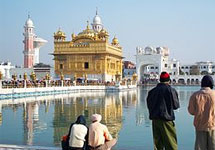
bath at the Golden Temple. A visit to Amritsar is
believed to wash off all the sins. |
|
A focal point of
Sikh faith, , a nursery of defence pool, an
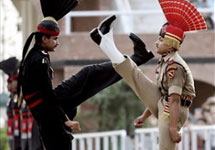
alert sentinel at the Indo-Pak border, Amritsar is
the place where the first Sikh Army was raised by
the sixth Guru, Guru Hargobind. The city saw the
fierce onslaughts of the invading armies of Ahmad
Shah Abdali and a reckless carnage at the
Jallianwala Bagh. An epicenter of Kooka and Akali
movements and a symbol of resistance against the
British tyranny, Amritsar had been a favourite
place of Maharaja Ranjit Singh. It was in Amritsar
that the clarion-call for the liberation of India
sounded louder and clearer. In the recent times,
the has at regular intervals borne the brunt of
Indo-Pak conflicts. |
|
The most
dominating asset, however, is its people who
are friendly, God-fearing, hospitable, hard
working informal, robust and with a tremendous
zest for living. They are fond of good food, good
dress and all the external symbols of life. |
|
Amritsar is the
heart-beat of the Majha region which has
provided Punjabi literature with its standard
language. A launching pad of several renowned
artists, authors and poets, the city has been a
home of handloom and carpet industry for more than
a century. The city is proud to have the second
largest Milk plant in the country. |
|
The Cultural
. Amritsar has immensely contributed to the
Punjabi literature and folk culture. It has
standardized the Punjabi language. The early
journey towards formal education has given it many
writers and poets of repute.
People of different languages, cultures, customs
and races came to Punjab for good life and it was
the strength and superiority of Punjabi culture
and language that these all immigrants forgot
their native culture and became Punjabi. |
|
The Hardworking
Punjabi. The region of Amritsar and Gurdaspur
is called Majha or the heartland. Amritsar has
always occupied the center stage in the Majha
region and been aptly named as the Mukut Mani, the
Jewel in the Crown. The region is not as fertile
as the Doaba region of Jalandhar and Kapurthala.
Punjabis, the name for people of Punjab, are the
most successful community in India. The people of
the Amritsar region are hardworking farmers,
traders and weavers. The tough and unforgiving
terrain has taught them to garner the best from
available resources. |
|
The Martial Race.
Amritsar has been the pivot point of the Sikh
religion and Punjab politics. The first Sikh army
was raised here and even today this region
contributes the maximum volunteers to the Indian
Army. The people have been quick to form
resistance movements; the Akali, Kooka movements
in the Indian freedom struggle against the British
and the call for Khalistan by Bhinderanwale
originated in this city. |
|
The brave and
carefree culture of soldiering is the second
nature for the people of Amritsar. The most
essential quality of the people apart from
soldiering is their hospitable and friendly
nature. A visit to the rustic villages and you
will promptly get scores of invitation to savor
the famous Tandoori Chicken, fried fish and home
made sugarcane wine or the Makki Ki Roti and
Sarson Ka Saag, a meal of corn flour pancakes and
a dish prepared with mustard leaves and stems,
kulche chole, and aloo wala kulcha. |
|
Festivals in
Amritsar. The major festivals are Lohri, Holi
(Hola Mahalla), Vaisakhi and Guru Nanak Birthday,
Guru Gobind Singh Birthday and Diwali. Lohri is
celebrated on the 13th of January as the end of
winter and the harvesting season. The next day is
the first day of the Sikh month and is celebrated
with offerings to Gurudwaras and the needy.
Baisakhi is the end of year for the Sikhs and is
celebrated on the 13th of July. It is the festival
of celebrations, of dance and signifies wealth and
prosperity. It is believed that the dance form
Bhangra, now popularized by the Punjabi singers
all over the world, originated as an expression of
gratitude to the mother earth during Vaisakhi.
Guru Nanak Birthday , the Birthday of Guru Dev Nanak
dev ji the founder of Sikhism, Guru Gobind Singh
Birthday the 10th Guru the founder of Khalsa.
|
|
Punjabi Music
Bhangra is one of the many Punjabi musical art
forms that is increasingly being listened to in
the west and is becoming a mainstream favourite.
Punjabi music is being used by western musicians,
in many ways, such as mixing it with other
compositions to produce award-winning music. In
addition, Punjabi Classical music is increasingly
becoming popular in the west due to the beauty of
sounds of the Punjabi language and its
composition. |
|
Punjabi Poetry
Punjabi Poetry is renowned for its extremely deep
meaning, beautiful, exciting and hopeful use of
words. The poetry is one of the deepest insights
into the Punjabi mindset. The large number of
Punjabi poetry masterpieces are being translated
throughout the world into many languages. Famous
Punjabi poets. |
|
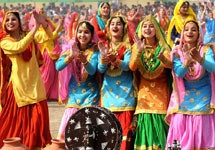
Punjabi Dances
Punjabi folk dance and music represent the true
colour and ardor of the common Punjabi people. As
people clad with colorful silk lungi, turban and
handkerchief turn around with their special folk
dance, bhangra to celebrate the success of
harvest, you can't control yourself from joining
them. This lively dance form has crossed its
regional barrier and has been touching the heart
of people around the whole world. If Bhangra is
the ultimate enjoyment of men then Giddha is the
most popular folk dance among the women in Punjab.
Jhumar, Dankara, Dhamal and Gatka are some other
folk dances that are equally vibrant and lively in
exciting people. |
|
Punjabi Cuisine
Tandoori chicken is a popular dish in Punjabi
cuisine.
Punjabi Cuisine has an immense range of dishes and
has become world-leader in the field so much so
that many entrepreneurs that have invested in the
sector have built large personal fortunes due to
popularity of Punjabi Cuisine throughout the
world.
Punjabi people are robust people with robust
appetites and their food is like the Punjabis
themselves, simple, sizeable and hearty with no
unnecessary frills or exotic accompaniments. The
Punjabi tandoori cooking is celebrated as one of
the most popular cuisines throughout the world.
Huge earthen ovens are half buried in the ground
and heated with a coal fire lit below it.
Marinated meat, chicken, fish, paneer, rotis and
naans of many types are cooked in this novel oven
and the results are absolutely scrumptious!
Punjab has imbibed some aspects of its cuisine
from external influences. Connoisseurs of the
cuisine say that the gravy component of Punjabi
cuisine came from the Mughals. The most popular
example is the murg makhani. It served the state
well to combine this influence in its cooking
since it had a lot of pure ghee and butter. Murg
makhani also provided a balance to tandoori
chicken, which was dry because it was charcoal
cooked. Nans and parathas, rotis made of maize
flour are typical Punjabi breads.
Winter, in Punjab, brings in the season of the
famous makki ki roti(maize flour bread) and sarson
ka saag(mustard leaf gravy). No meal is complete
without a serving of lassi( sweet or salted drink
made with curd) or fresh curd and white butter
which is consumed in large quantities. The other
popular dishes, which belong exclusively to
Punjab, are ma ki dal, rajma (kidney beans) and
stuffed parathas.
A predominantly wheat eating people, the Punjabis
cook rice only on special occasions. It’s never
eaten plain or steamed, for steamed rice implies
that somebody is sick. Rice is eaten always with a
Bagar (flavoring) of cumin or fried onions with
Rajma or Kadhi, Rajma with rice or rice with Kadhi
is eaten or holidays or on festive days. In winter
rice is cooked with Gur or with peas called
matarwale chawal or as a delicacy called Rao Ki
Kheer which is rice cooked on very slow fire for
hours together with sugar cane juice.
The celebrated papad and vadian from Amritsar have
become the subject of many a rhymes and jingles,
Amritsaris have a sweet tooth for pinnis,
balushahis and gur ka halwa.The city has many
places for traditional cuisines and modern
foods.Most of the eating joints of the traditional
cuisines and modern foods.Most of the eating
joints of the traditional cuisine are within the
walled city. |
|
 |